
KEW GARDENS HISTORY
History of Kew Gardens
Kew Gardens, located in southwest London, is one of the world’s most renowned botanic gardens and a UNESCO World Heritage Site. Established and opened to the public in 1840, its origins trace back to the early 18th century. Managed by the Royal Botanic Gardens, Kew Gardens includes 132 hectares of ground and is home to the largest and most diverse botanical collection in the world.
It houses over 50,000 living plant species and a herbarium with over 7 million items. Its historic landscape includes iconic glasshouses and listed buildings, making it a top tourist attraction and a center for botanical research and education.

A royal connection
The origins of Kew Gardens trace back to 1299 when Edward I moved his court to a manor house in the nearby area of Richmond, then called Sheen. In 1501, Henry VII built Sheen Palace, which later became his permanent royal residence under the name Richmond Palace.
Around the beginning of the 16th century, courtiers attending Richmond Palace settled in Kew and started building large houses in the area. Among the early royal residences was Mary Tudor’s house, which was connected to Richmond Palace by a driveway that was built in 1522. Around 1600, the area now known as the gardens was called Kew Field, a large piece of farmland belonging to one of the newly established private estates.

The royals who shaped Kew
The exotic garden at Kew Park was initially created by Henry Capell, 1st Baron Capell of Tewkesbury. The formal establishment of Kew Gardens in 1759 was further expanded by Augusta, Dowager Princess of Wales, widow of Frederick, Prince of Wales.
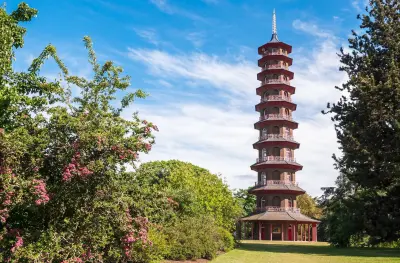
William Chambers worked on the garden’s design, constructing several unique structures, including the Orangery currently used as a restaurant and the Great Pagoda, built in 1762, which still stands today. Under George III, the gardens thrived, with significant input from William Aiton and Sir Joseph Banks. Queen Charlotte’s cottage, built along the riverside, served the Royal Family as a resting place during their walks in the gardens.

Seeds of history
Kew Gardens, as it stands today, started in 1772 with the merging of the royal estates of Richmond and Kew. Early plant collections included plants from William Coys’ garden at Stubbers in North Ockendon.
That year, Francis Masson, Kew’s first plant collector, brought back thousands of plant species from South Africa. In 1773, the landscape architect Capability Brown designed the Hollow Walk, now the Rhododendron Dell. By 1788, Kew’s global reach was evident when two of its gardeners joined the HMS Bounty’s on a mission to Tahiti to collect 1,000 breadfruit plants, a voyage later infamous for its mutiny.
In 1802, King George III unified the Richmond and Kew estates, forming the foundation of Kew Gardens. The old Kew Park, later renamed the White House, was demolished. The nearby Dutch House, purchased as a royal nursery, became known as Kew Palace and stands today as a symbol of its rich history.
Kew becomes a national treasure
In 1840, Kew Gardens transferred from the Crown to the Government and became a national botanical garden, thanks largely to the initiatives of the Royal Horticultural Society and its president, William Cavendish. The Gardens were opened to the public. Under the direction of Sir William Hooker, Kew’s director, the gardens expanded significantly, growing to 30 hectares, with the arboretum extending to 109 hectares. John Smith was appointed as Kew’s first curator.

The Palm House
The iconic Palm House, designed by architect Decimus Burton and ironmaker Richard Turner, was built between 1844 and 1848. The Palm House provides a perfect warm and humid environment for tropical plants. Its glass panes allow light to come in, supporting a variety of exotic species, some rare or endangered. During the 19th century, Kew played an important role in successfully growing rubber trees, enabling their cultivation outside South America.
The Campanile
The Palm House was originally heated by two coal-fired boilers, with a 33-meter chimney, now known as the Campanile, near Victoria Gate. Coal was delivered by a small railway in a tunnel, using hand-driven wagons. The tunnel also served as a passage, but it proved inefficient, so two smaller chimneys were added to the Palm House. In 1950, the railway was electrified. Today, the tunnel carries hot water from nearby oil-fired boilers.

The Waterlily House
The Waterlily House at Kew, built in 1852, is the hottest and most humid of the greenhouses. It includes a large pond with water lilies and heat-loving plants and closes during winter. It was originally built to house Victoria amazonica, the largest water lily species, but the plant initially struggled to grow there due to poor ventilation and was moved to another house. The ironwork was supplied by Richard Turner, and the Palm House initially heated the house before getting its own boiler.
The Temperate House
The late 19th and early 20th centuries were important for Kew Gardens’ development. In 1852, the Herbarium was built, now housing over seven million plant specimens. Temperate House, the world’s largest Victorian glasshouse, opened in 1863 and was completed in 1899. It features rare plants from temperate regions and a viewing gallery for visitors. Temperate House underwent a major renovation at a later stage, and after five years of renovation, it reopened in 2018.
Joseph Dalton Hooker became director in 1865, strengthening Kew’s focus on scientific research. In 1876, the Jodrell Laboratory was established to support studies on plant diseases and latex production. The Marianne North Gallery opened in 1882, showcasing her famous botanical art. In 1896, Kew started employing women as gardeners, marking a significant milestone.
Book one of our popular Kew Gardens tickets to explore the world’s largest living plant collection!

Skip-the-line
Kew Gardens Ticket
Get ready for a day of relaxation among the lush greenery in Kew Gardens. Visit the world's largest Victorian glasshouse, see exotic plants from the rainforest in the Palm House, travel through ten climate zones in the Princess of Wales Conservatory, walk among the treetops on the Treetop Walkway, and more! Your ticket includes a map of the gardens and a seasonal highlights guide.

Visit Kew Palace & the Kew Gardens
Kew Palace Tickets
The Kew Palace Tickets allow you to visit one of the biggest botanical gardens in the world. Walk through the charming Kew Gardens, which are home to over 50,000 living plants, and learn about its incredible biodiversity. You will have access to the former residence of royals, the Treetop Walkway, as well as art galleries. This is an ideal opportunity to escape the hectic urban environment and relax.

Science and conservation
The 20th century was a period of significant progress for Kew Gardens in science and conservation. In 1930, the Imperial Bureau of Mycology moved near the Herbarium, and during World War II, Kew provided support by growing vegetables and medicinal plants. In 1952, Crick and Watson’s discovery of DNA’s structure laid the foundation for Kew’s work on plant genetic diversity. Kew launched his Diploma in Horticulture in 1963, and began seed research, as well as advanced biochemical systematics. Kew opened a low-temperature seed bank at Wakehurst in 1978 to preserve plant diversity. The restored Japanese Gateway was unveiled by Princess Sayako in 1996 and the following year, a donation from the Wellcome Trust funded the Millennium Seed Bank, supporting Kew’s efforts in global plant conservation.
Princess of Wales Conservatory
The Princess of Wales Conservatory, designed by Gordon Wilson, opened in 1987 and was opened by Diana, Princess of Wales, in honor of Augusta’s ties to Kew. It replaced 26 smaller buildings and won the Europa Nostra award for conservation in 1989. The conservatory is the most complex glasshouse at Kew, with ten micro-climatic zones, housing orchids, water lilies, carnivorous plants, and bromeliads, with cacti occupying inside and outdoor areas. Covering 4,499 square meters, it is energy-efficient, with cooler zones on the outer edges and tropical zones in the heat-conserving center. During its construction, a time capsule containing crop seeds, endangered plant seeds, and conservation publications was buried beneath it.

Fire and storm
Kew Gardens has faced its share of challenges throughout history, from acts of protest to natural disasters. In February 1913, suffragettes Olive Wharry and Lilian Lenton set fire to the Tea House at Kew Gardens as part of a series of arson attacks in London. Kew Gardens faced another significant loss during the Great Storm 1987, which destroyed hundreds of its trees.
Alpine House
The Davies Alpine House, opened in 2006, is Kew’s third alpine house since 1887. Its design provides excellent ventilation, prevents overheating with automatic blinds, and uses special glass to maximize light. Cooling is energy-efficient, using underground pipes to maintain temperatures below 20°C. Kew’s alpine collection includes over 7,000 plants, with 200 displayed at a time and rotated regularly.

The Hive
The Hive, opened in 2016, is a unique multi-sensory installation that celebrates the fascinating life of bees. Standing 17 meters tall in a wildflower meadow, it was designed by English artist Wolfgang Buttress. Made from thousands of aluminum pieces in a honeycomb shape, it offers visitors an interactive experience. Initially a temporary exhibit, it became a permanent part of Kew Gardens because of its popularity.
Journey of the Kew Gardens through innovation
Between 2006 and 2016, Kew Gardens achieved key conservation, education, and public engagement milestones. In 2006, the award-winning Crossing was opened to bridge the Lake, followed next year by the banking of the billionth seed at the Millennium Seed Bank. In 2008, Kew introduced the Treetop Walkway and the Shirley Sherwood Gallery of Botanical Art. In 2009, Kew celebrated its 250th anniversary with a visit from The Queen and Prince Philip, and the Herbarium and Library were expanded to accommodate 30,000 new items added annually.
Kew launched the ‘Grow Wild’ campaign to promote planting native wildflowers. In 2016, the Great Broadwalk Borders were completed, and Kew published the first State of the World’s Plants report. In 2018, the Great Pagoda reopened after restoration, with 80 magnificent dragons returned to its roofs.
Kew Gardens today
With over 260 years of history, Kew Gardens is a popular destination known for its stunning landscape and diversity of flora. It is a place to relax and find inspiration. Kew Gardens is also a global leader in botanical research, focusing on conservation, climate change, and sustainable use of plant resources. As an educational center, it teaches visitors about plants, ecosystems, and the importance of biodiversity.
Kew actively participates in international conservation projects to protect endangered plants and ecosystems. The iconic gardens, which have had their own police force since 1845, remain a top tourist destination, attracting over 2 million visitors every year.
Do you want to experience more than just the Kew Gardens?

London history & nature
Kew Gardens Ticket & Westminster Walking Tour
Visit more than 20 top attractions in London on a walking tour with a local guide! See Big Ben, Houses of Parliament, Buckingham Palace, Trafalgar Square, and more. You can see the Changing of the Guard at certain times. Then, walk around Kew Gardens and see thousands of trees and tropical plants, walk among the treetops on the Treetop Walkway, and have a picnic. You can select a small or private group experience.

Access to 90+ attractions
London Pass
The London Pass offers access to more than 90 London attractions! You can visit the London Eye, the Tower of London, Tower Bridge, Shakespeare's Globe Theater, the London Zoo, football stadiums, and Madame Tussauds, and enjoy a hop-on hop-off bus tour, a cruise on the Thames, a food tour, and more. The pass is valid for 1-10 days, making it perfect for your visit, however long it is.